|
About the Instructor
Classes are instructed by Kaoru Murase Sensei (4th Dan). He started practising
aikido in Australia under Stewart Retford (5th Dan) at the AKI Tweed Heads
dojo. For the past 11 years he has trained at the AKI honbu under Takeda
Shihan attaining the ranking of 4th Dan. He has given aikido seminars in
many countries around the wold including Indonesia, Australia, Canada and
America.
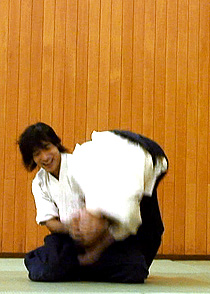
I'm a Private Investigator and an Aikido instructor.
Hello, nice to meet you. I'm Murase
Kaoru. I'm a Private Investigator and
an Aikido instructor. As a student I
was a boxer, but unfortunately I wasn't able to keep it up after an automobile
accident. Much later, when I was 27 years old, I began practicing Aikido under Takeda Yoshinobu Shihan (AKI /
Shonan Aikido Federation). There I was thrown until I thought I would pass out,
and I became fascinated with the Aikido world. I also began practicing Aikido
at Hari Sunao Shinan's dojo and now I train at these two dojos, teach Aikido at
the Canadian embassy and a facility in Minato Ward. Although I'm obsessed by Aikido, my "day" job working as
a private investigator. What would you
guess about private investigators? It might be an unexpected job to some of
you. So I would like to talk about investigators....
click here to read more...
Keiko
Keiko (practice) is high energy with an
emphasis on sensitivity and adaptability to our partner’s movement. Murase
Sensei’s approach goes beyond performing techniques to exploring motion and capturing
the feeling of aikido. Students work together to learn the principles of
aikido and to develop a personal understanding of these principles.Classes
are mixed ability with instruction in Japanese and English. Beginners are
very welcome.
One of the things that makes Aikido special for me
is the fact that the waza or techniques are only one small part of what makes
up the practice. To be sure, one can only really understand Aikido if they feel
it happen to them thousands of times, over and over. Taking ukemi is the way to
study this art. One’s
body is a sensor, and using that sensor to understand what Aiki is, rather than
philosophizing endlessly about the physics or metaphysics of it is the key one
mustn’t forget. That said, O-sensei
wrote about Aikido as a path to true peace, as a way to cleanse the world of
destructive forces and tendencies. That philosophical aspect of the art is
something that translates to every part of one’s
life, and affects how we relate to one another as human beings. This is much
bigger than methods of self-defense against various attacks, yet it resists
analysis unless one practices the physical aspect and pushes through to
enlightenment without thought. This Zen concept is something that must be
learned and is not intuitively obvious.
Aikido practice allows one to approach many goals in many ways. One can be
fascinated by the martial aspects of how to subdue an attacker, and hone one’s body and mind into a
formidable anti-weapon. One can also be engaged in the pursuit of a way to
maintain one’s center in the face of
violence and conflict, by practicing metaphoric conflict in the form of kata,
and developing a stronger sense of self and a feeling of compassion for all
humanity, escaping from the trap of falling for one’s anger and violence, or one’s fear and flight response. By
knowing that one will survive a conflict situation and can even cause positive
change in the interaction without resorting to violence, we can know how to
better the world, and to practice this in a safe environment, we practice
Aikido.
Aikido practice, being physical, allows us to learn about ourselves and
exchange information with one another in a way that is totally different from
how we are taught elsewhere. Japanese culture has a term “skinship” which refers to touch as a
way to relate to one another on a very primal level. That is largely
disappearing from normal daily interactions, and yet is so vital to who we are.
Aikido practice allows for the sensing of each other’s energetic fields through
close contact, and to enter into an interaction that is like a conversation,
but has its roots in martial movements from other arts like sword and jujutsu.
The conversation allows us to learn how to sensitize ourselves to this energy
and to use it to generate great power and have almost magical effects at its
highest levels.
Everyone brings who they are to the mat, and thus Aikido is as broad as
humanity, inclusive of very hard styles that seem interested only in domination
and even injury of an attacker, as well as soft styles that seem almost totally
removed from martial application. The terms “satsu
jin ken” (killing sword) and “katsu jin ken” (life giving sword) are
paradoxical, and yet each has a place in Aikido practice and philosophy. The
sword movements in Aikido practice are both deadly and instructive in nature:
Rather than killing your partner as you slice the air, you teach them correct
movement with your sword, tracing a life-giving line that prevents injury both
to you and your partner, as well as ending the conflict decisively in your
favor with a pin or throw.
We must all find a practice that resonates with who we are, or we will not find
our path. Most of us also practice to better ourselves, and thus to better the
world. It would seem learning sensitivity is a key to beginning this type of
understanding, and one finds that being sensitive in ones ukemi allows for ever
infinite responses and thus options for dealing with conflict in the world and
on the mat
|
|
Philosophy
of Aikido
ByHoward
Dyke
A.K.I. Canadian Embassy Aikido Club 21
September, 2005
Prologue
Aikido - The Way of Harmony with Universal Energy
Sir Isaac Newton’s Laws of Motion
1.When no force acts on an object (or
when the forces acting upon it cancel), it moves in a straight line at a
constant speed.
2.The acceleration of an object equals
the total force acting on it, divided by its (constant) mass.
3.Whenever one body exerts force upon a second body, the second body exerts an equal and opposite force upon the first body.
Philosophiae Naturalis Principia Mathematica, July 5, 1687
Introduction
When I joined the Canadian Forces Military Police in 1985, my first
exposure to any formalized martial arts came in the form of classes called
Arrest and Restraint Techniques. We were
told at the time that the skills were based upon Aikido techniques; however I
really did not know anything else about Aikido.Over the years, I have read many
generalizations that characterized Aikido as a martial art in which one uses
the attacker’s own force against them.
While this is a fairly simple statement and essentially true, I believe
that Aikido goes much deeper than that. People
who train in any one martial art usually become ardent proponents of that art
and often claim that “their” style is superior to other forms of martial
arts. I would not debate with anyone
that Aikido is better than another art.
I may be better suited to train in Aikido while another person is better
suited to train in another style. However
I will attempt to show that Aikido is a true art that is firmly based in
nature, science and spirit.
Aikido and Nature
In the
purely physical sense, Aikido techniques are well based in science and
therefore, in nature itself. When Sir
Isaac Newton laid out his three laws of motion over three hundred years ago, he
described universal truths that apply to the physical movement of all objects.While
many Aikidoka probably rarely ponder
this, the movements we perform in Aikido, as either Nage or Uke, follow these
universal laws of motion.In Aikido we always try to remain aware of our hara or center. We position our hara in relation to our partner’s hara for a technique to be truly effective. The energy or force from our hara is merely
transmitted to Uke’s hara through the arms, joints and hands.As an example, if Uke
makes a committed shomen uchi attack
in practice, they have accelerated their body.
If Nage chooses to step to the side and allow Uke to go past, we have
observed Newton’s first law of motion, (When no force acts on an object (or when the
forces acting upon it cancel), it moves in a straight line at a constant speed).Upon
receiving a committed shomen uchi attack, if Nage chooses to perform ikkyo, they redirect Uke’s force. This demonstrates Newton’s second law of
motion where Uke’s initial force, combined with Nage’s response, moves Uke in a
new direction. (The acceleration of an
object equals the total force acting on it, divided by its (constant) mass.)Newton’s
third law of motion, (Whenever one body
exerts force upon a second body, the second body exerts an equal and opposite
force upon the first body) can be seen, or more accurately, felt, in most
aikido techniques. As an example, during
katate dori jiyu waza , if uke makes
a very committed, or boisterous attack, we can feel the force transmitted from
his hara. We can momentarily accept and
absorb the force and then send it back towards Uke’s hara. Another option is to begin moving our hara
forward just before Uke makes contact.
Either way, the opposing force from Uke is countered and Nage prevents
himself from being moved backward. We
are countering the effects of Newton’s third law of motionI.Just as the universal laws of motion apply to all objects, we can see that
they apply to Aikidoka in practice.
Because Aikido places so much importance on the hara, or center of the
human body, Aikido follows a more pure interpretation of these physical
laws. When we watch astronauts in orbit
we often see them spinning in the weightlessness of space. It is no coincidence that their bodies spin
around their hara. takeda Sensei and Murase Sensei, both often
say, “Forget about technique.” When we
stop thinking about a specific technique and concentrate on feeling our
partner’s hara, we begin to achieve this pure form of motion, or energy.
Aikido Relationships
One of the most important aspects of Aikido involves relationships. Whether it’s in a physical sense and how
Nage moves in accordance with Uke’s motion, or in a spiritual sense. Like the universe, Aikido
relationships are many and complex. At
the very beginning of practice we meet and begin working together to place the tatami mats in the dojo. This sets a tone of cooperation. When we
begin formal practice there is a certain amount of ceremony in which etiquette
is reverently observed. Throughout
practice we continue to observe etiquette by bowing to each individual partner
before and after practicing with them.
This magnifies the sense of cooperation and solidifies a strong sense of
respect between each other.Aikido is also unique from other martial arts in that
there is no competition, sparring or fighting.
We practice together in harmony with a common goal of learning together. We don’t regard each other as opponents but
as partners.During practice, one often hears the advice, “Move with
partner.” Not only do we regard others
in the dojo as partners, but we also move with them to perform techniques. Uke’s role of offering a committed attack
and then taking good ukemi is just as
important as Nage’s role of performing the actual technique. By making this sacrifice, Uke helps Nage to
better learn the technique being practiced.In Aikido, attacks only exist in
order to facilitate training. All Aikido
techniques are defensive in nature and this again ties in with its core
philosophy. Put simply, if you are not
attacked, there is no need to attack another.Instead of holding competitions in
which people fight, in Aikido we conduct demonstrations where we practice
together and then demonstrate techniques to each other. Again, we see the harmony, cooperation and
energy in Aikido.
Aikido and Teaching
The most important
relationship that occurs within Aikido is between a Sensei and student. A Sensei has the most important role in
Aikido as he has a duty to teach Aikido techniques as accurately as
possible. This ensures that Aikido is
preserved and passed on in the manner that O’Sensei
intended and that the art is never lost.As a teacher, one should also recognize
the strengths in each student and attempt to teach them in ways they can
understand. When I teach some students
I use spiritual terms to explain their hara to them, or how to use it in
performing a technique. For other
students, I might use more scientific terms, like “centre of gravity” instead
of hara. If someone does not yet accept
or understand the spiritual aspects of Aikido, they may learn the physical
aspects more easily by thinking in basic scientific terms. After they learn the physical aspect and
begin to feel it, hopefully then they can begin to understand the spiritual
aspects as well.In the role of teacher, one should also never forget to
continue learning. Just as one may
teach a student something, the Sensei should also keep their mind open to
things they can learn from their students.
Whether it is discovering a new way to explain a concept; teaching a
student with unusual physical abilities; or helping a student overcome physical
limitations, the teacher is continually faced with the opportunity to learn as
they teach.
Aikido and Self
While Aikido does not have competition or fighting, challenges still
exist. In practice, by following the
examples of teachers and peers, Aikidoka learn to push themselves past their
own physical limits. In this way,
Aikido becomes a path of self-improvement.
By constantly learning from those around us and through physical
training, it provides a balance between body and mind while improving both.On a
personal level, at the age of thirty-eight, I have trained much harder in
Aikido than I ever did as an eighteen year old in basic training in the army. In the time that I have been training in
Aikido, I feel that any physical improvements I have made have been matched, if
not surpassed, by spiritual, mental and emotional improvements.It could be
interpreted that the biggest challenge in Aikido is mastering oneself. There is no importance in defeating an
opponent in competition. The true test
is learning to achieve self control and peace.here is a saying amongst
Westerners who come to live in Japan.
It is to the effect that: After
living in Japan for a few months I believed I had learned enough to write a
book. After living in Japan for a
couple of years, I realized that I knew nothing about Japan. 。After training in
Aikido for only a few weeks, I felt that I had learned a few techniques fairly
well and believed that I understood Aikido as an art. Now, after training for two years, I have discovered how much more
there is still to learn.
Conclusion ? Philosophy of Aikido
It
might be impossible to summarize one philosophy for Aikido however certain
truths exist. Aikido is based in nature
and in that regard is universal. It
blends the physical world, defined by scientific laws of motion and the
spiritual. Aikido, like nature, is
there for everyone to experience. Just
as two people may look at a cloud in the sky and see different things,
different people may learn and draw different things from Aikido.By training,
working and learning together in harmony, Aikidoka help each other on this path
of discovery and self improvement.do not believe that Aikido was invented. I feel a more accurate description is that Aikido is a certain
truth within the universe that was discovered by O’Sensei. He then shared his discovery with the rest
of the world, and for that we should be grateful.
|